
An artistic and political adventure since 1965
For more than half a century, the Théâtre des Amandiers has accompanied the transformations of Nanterre and, with them, those of French public theatre. Born in the heart of the 1960s from an ambitious political and cultural project, it has gradually established itself as a major place for creation, training and artistic reflection, recognized far beyond the borders of the Paris suburbs.
From an experimental festival to a major national drama center, from a neighborhood theatre to an internationally renowned artistic laboratory, the Théâtre des Amandiers alone encapsulates more than fifty years of cultural, social and political history.
Its story is that of a public theatre that has remained faithful to its founding principles: to create and share, to transmit and experiment, to constantly invent new ways of making theatre with and for the city.
A founding encounter in the heart of the 1960s
In 1965, Nanterre was a working-class town of nearly 90,000 inhabitants, undergoing rapid urban expansion. New neighborhoods were emerging, but cultural offerings remained limited: a few cinemas, a community hall, no theatre, no cultural center.
At the same time, France was launching a major policy of theatrical decentralization to establish creative venues outside Paris.
It was in this context that Raymond Barbet, mayor of Nanterre since 1935, met Pierre Debauche, actor and director. The former was convinced that culture should be a tool for popular emancipation. The latter dreamed of bringing to the theatre “those who have never been.”
From this convergence emerged a simple yet bold project: to create in Nanterre a theatre festival accessible to all. What was still an experiment would soon become an institution.
The founding festivals, or the invention of an audience
The first festival in 1965 immediately asserted a high artistic ambition. Pierre Debauche staged The Lower Depths by Maxim Gorky, adapted by Arthur Adamov, with Silvia Monfort. Roger Planchon presented The Surprise of Love by Marivaux.
From this very first edition, the project stood out for the quality of its invited artists and its desire to reach a wide audience.
The second festival, in 1966, marked true public recognition. Set up in disused hangars of the Camp de la Folie, it attracted more than fourteen thousand spectators. Two productions became emblematic.
The Four-Leaf Clover presented four plays, each performed in four languages – French, Arabic, Portuguese and Spanish – making multilingualism both a political and poetic gesture.
Oh! What a Lovely War became a huge popular success. This satire of World War I was performed two hundred and forty-five times until 1968, then revived in 1972. It left a lasting impression on audiences in Nanterre and established the Amandiers as a place for political and popular theatre.
The third festival, in 1967, held at the Palais des Sports in Nanterre, confirmed the scale of the phenomenon. Up to a thousand spectators attended performances. The program combined theatre, music, dance, debates, and shows in Arabic and Portuguese.
At the end of these three editions, one conclusion was clear: a theatre had been born in the city.
Theatre beyond its walls and the trial of 1968
In 1968, while awaiting a permanent venue, Pierre Debauche chose to bring theatre closer to the people. The troupe performed in factories, neighborhoods, schools, community halls and at the university. He launched the “Ten Theatres of Nanterre,” spreading theatre throughout the city.
During the May ’68 strike, the theatre officially ceased operations, but the Amandiers collective gave sixty-five performances in twenty-seven companies and six schools. Theatre then became a direct tool for circulating ideas, political debate and cultural education.
This moment permanently shaped the image of the Amandiers as a grassroots theatre, engaged in social life.
Rue Greuze, or the birth of a permanent artistic presence
In September 1969, a temporary theatre was inaugurated on Rue Greuze. Pierre Debauche and Pierre Laville took charge of its direction.
This period was decisive for the identity of the venue. Debauche established a true artistic continuity: performances throughout the year, theatre for children, post-show discussions, productions in foreign languages, and constant attention to immigrant workers.
Gradually, a community of loyal spectators formed. The Amandiers acquired a lasting identity: that of a theatre deeply rooted in the social life of Nanterre.
1976: a building for a project that had become national
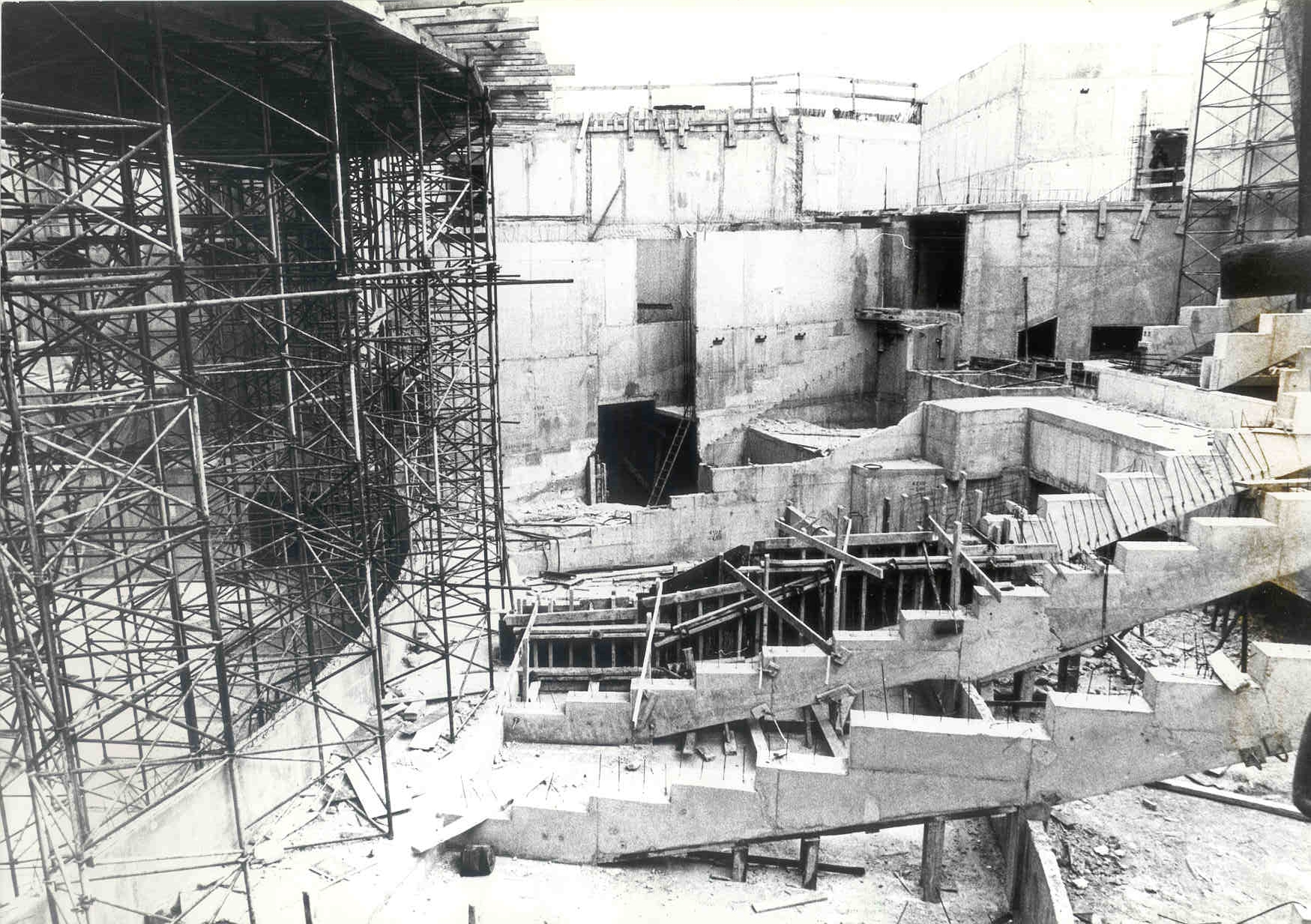
After several years of planning and construction, the new theatre opened in September 1976 at 7 avenue Pablo-Picasso. It became both a Maison de la Culture and a National Drama Center.
The opening was marked by major productions: The Dispute by Marivaux directed by Patrice Chéreau, Tartuffe by Molière directed by Roger Planchon, Summerfolk by Gorky directed by Peter Stein, as well as two operas by Handel and Rossini.
The Amandiers then entered a new dimension—architectural, artistic and institutional.
Major artistic directions
Pierre Debauche, or the invention of popular theatre (1965–1978)
As the founder, Pierre Debauche established the Amandiers’ guiding principles. He developed a political theatre accessible to all, closely connected to the working class and popular neighborhoods.
His major artistic milestones remain inseparable from the founding festivals, the lasting success of Oh! What a Lovely War, the factory tours of 1968, and the creation of a permanent program on Rue Greuze.
He left behind a theatre firmly rooted in the city and recognized on the national stage.
Raoul Sangla, or opening to all the arts (1978–1982)
With Raoul Sangla, the Maison de la Culture underwent a significant shift. A journalist and television figure, he opened the program widely to music, dance, cinema, visual arts and audiovisual creation.
Traditional celebrations, such as the Fête de la Rosière, were transformed into contemporary cultural festivals.
The Amandiers thus became a multidisciplinary venue, preparing the arrival of a new generation of creators who would profoundly renew theatrical aesthetics.
Patrice Chéreau and Catherine Tasca, theatre as utopia (1982–1991)
The arrival of Patrice Chéreau marked a historic turning point. He transformed the Amandiers into a European laboratory for creation and founded an acting school within the theatre.
Highlights of this period include the first major works of Bernard-Marie Koltès, notably Black Battles with Dogs, and the monumental production of The Screens by Jean Genet.
The workshops also hosted major film shoots, such as The Wounded Man and later Queen Margot.
Chéreau described these years as a time of “frenzied energy,” where actors, students, writers and audiences constantly intersected. This period gave the Amandiers lasting international recognition.
Jean-Pierre Vincent, a return to text (1991–2001)
Jean-Pierre Vincent extended the artistic rigor inherited from Chéreau. He developed major productions of Marivaux, Brecht and Ibsen, with particular attention to acting.
His theatre remained political while gaining clarity and formal precision.
Under his direction, the Amandiers consolidated their place as one of Europe’s leading venues for text-based theatre.
Jean-Louis Martinelli, theatre to think the world (2002–2013)
Jean-Louis Martinelli asserted a clearly political and intellectual vision. He believed theatre should challenge consensus, bring forth the unheard, and nourish civic reflection.
Highlights include A Doll’s House by Ibsen with Marina Foïs, as well as numerous works addressing war, totalitarianism, ideological conflicts and European memory.
He also developed debate cycles, meetings with philosophers and writers, and a demanding international program.
The Amandiers became a central venue for contemporary political theatre.
Philippe Quesne, theatre as experience (2014–2021)
With Philippe Quesne, the venue’s aesthetics changed profoundly. Coming from the visual arts, he turned theatre into a space for experimentation blending installation, performance, music and visual arts.
With his company Vivarium Studio, he created works such as The Melancholy of Dragons, The Night of the Moles and The Parade of the Moles, transforming the entire theatre into a vast artistic installation.
He also developed major participatory projects such as Atlas Nanterre, Ça ira (End of Louis) by Joël Pommerat, The Show Must Go On by Jérôme Bel and the festival Possible Worlds.
The Amandiers became a theatre of experience, open to residents and contemporary stage forms.
Christophe Rauck, transmission and renewal (since 2021)
Since 2021, Christophe Rauck has opened a new chapter in the context of the renovation project.
His vision is based on transmission, supporting emerging artists, and shared seasons with associated creators. He strengthens the presence of contemporary writers, develops the Atelier—a two-year professional training program—and expands national and international collaborations.
During the renovation, activities continue in a temporary theatre and off-site, in close connection with local residents.
On December 18, 2025, the Théâtre Nanterre-Amandiers reopened in a fully renovated, modern and transparent building designed by the Norwegian agency Snøhetta.





 Station Théâtre des Amandiers – Palais des sports
 - arrêt Nanterre-Préfecture
 - Arrêt Nanterre-la-Folie
Ajoutez le site sur votre écran d'accueil pour un accès plus rapide !
Appuyez sur
puis “Sur l'écran d'accueil”